

Dependency Injection: 35 Dependency Injection interview questions
DI Fundamental

DI Fundamentals
- What is Dependency Injection and why is it used in modern software development? Dependency Injection (DI) is a design pattern that allows the creation of dependent objects outside of a class and provides those objects to a class in various ways. It is used in modern software development to improve code modularity, ease testing, and enhance maintainability. Example:
   class Engine
class Car(private val engine: Engine)
fun main() {
val engine = Engine()
val car = Car(engine)
}- Explain the concept of Inversion of Control (IoC) and how it relates to Dependency Injection. Inversion of Control (IoC) is a principle where the control of objects or portions of a program is transferred to a container or framework. Dependency Injection is a specific form of IoC where the container provides the dependencies that a class needs. Example:
   interface Engine {
fun start()
}
class PetrolEngine : Engine {
override fun start() {
println("Petrol engine started")
}
}
class Car(private val engine: Engine) {
fun start() {
engine.start()
}
}
fun main() {
val engine: Engine = PetrolEngine()
val car = Car(engine)
car.start()
}- What are the main advantages of using Dependency Injection in a software project?
- Improved Testability: Dependencies can be mocked or stubbed.
- Loosely Coupled Code: Classes are less dependent on concrete implementations.
- Enhanced Maintainability: Easier to manage and update dependencies.
- Better Separation of Concerns: Each class has a single responsibility.
- Describe the impact of Dependency Injection on the maintainability of code. Dependency Injection enhances maintainability by making the code more modular and easier to update. Changes in dependencies require fewer modifications in the dependent classes. It also makes the codebase more readable and easier to understand.
- Can you explain the Dependency Inversion Principle and how it differs from Dependency Injection? The Dependency Inversion Principle (DIP) is a principle where high-level modules should not depend on low-level modules. Both should depend on abstractions. Dependency Injection is a technique to adhere to DIP by injecting dependencies rather than creating them within the class. Example:
   interface Engine {
fun start()
}
class PetrolEngine : Engine {
override fun start() {
println("Petrol engine started")
}
}
class Car(private val engine: Engine) {
fun start() {
engine.start()
}
}
fun main() {
val engine: Engine = PetrolEngine()
val car = Car(engine)
car.start()
}
Types of Dependency Injection
- Compare and contrast constructor injection versus setter injection.
- Constructor Injection: Dependencies are provided through the constructor. It ensures that the dependencies are provided at the time of object creation.
- Setter Injection: Dependencies are provided through setter methods. It allows dependencies to be optional and set or changed after object creation. Constructor Injection Example:
class Car(private val engine: Engine)Setter Injection Example:
   class Car {
lateinit var engine: Engine
fun setEngine(engine: Engine) {
this.engine = engine
}
}- When would you use method injection instead of constructor injection? Method injection is used when the dependency is needed only for a specific method rather than the entire class lifecycle. It is less common but can be useful for injecting dependencies in methods that require them temporarily. Example:
   class Car {
fun drive(engine: Engine) {
engine.start()
println("Car is driving")
}
}- Can mixing different types of injection in the same class lead to issues? If so, what kind? Yes, mixing different types of injection can lead to confusion and increased complexity. It can make the class harder to understand and maintain, as the lifecycle and initialization order of dependencies might become unclear.
- Is there a preferred type of dependency injection when working with immutable objects? Please explain. Constructor injection is preferred for immutable objects because it allows all dependencies to be provided at the time of object creation, ensuring that the object remains immutable throughout its lifecycle. Example:
class Car(private val engine: Engine)- How does each type of dependency injection affect the ease of unit testing?
- Constructor Injection: Makes unit testing easier by ensuring that all dependencies are available and immutable from the start.Setter Injection: Allows more flexibility in setting up tests, but can make the object state harder to manage.Method Injection: Useful for testing methods in isolation without setting up the entire object.
@Test fun testCarStart() { val engine = mock(Engine::class.java) val car = Car(engine) car.start() verify(engine).start() }
DI Containers & Frameworks

- What is a Dependency Injection container and what are its responsibilities? A Dependency Injection (DI) container is a framework responsible for managing the creation, configuration, and lifecycle of dependencies. It automatically provides the necessary dependencies to classes when they are instantiated. Responsibilities:
- Creating Objects: Handles object creation and lifecycle.
- Managing Dependencies: Resolves and injects dependencies.
- Configuration: Configures dependencies based on predefined rules.
- Scope Management: Manages the scope of object instances (singleton, prototype, etc.). Example:
   // Using Koin DI container
val myModule = module {
single { Engine() }
factory { Car(get()) }
}
startKoin {
modules(myModule)
}
val car: Car by inject()- Can you list some popular Dependency Injection frameworks and their distinctive features?
- Dagger: Compile-time dependency injection, fast and efficient, suitable for Android.
- Koin: Lightweight, Kotlin DSL, easy to set up and use.
- Hilt: Built on Dagger, provides a more streamlined experience for Android. Example with Koin:
   val appModule = module {
single { Engine() }
factory { Car(get()) }
}
startKoin {
androidContext(this@MyApplication)
modules(appModule)
}- What is the difference between a Dependency Injection container and a service locator?
- DI Container: Dependencies are injected automatically by the container without the class needing to request them. This promotes loose coupling.
- Service Locator: The class actively requests the dependencies it needs from a centralized registry. This can lead to more tightly coupled code. Example:
   // DI Container Example
class Car(engine: Engine)
// Service Locator Example
class Car {
val engine = ServiceLocator.getEngine()
}- How do you configure dependencies within a DI container typically? Dependencies are configured by defining modules or components that specify how to create and inject dependencies. Example with Koin:
   val myModule = module {
single { Engine() }
factory { Car(get()) }
}
startKoin {
modules(myModule)
}- Describe a situation where you should opt for a lightweight DI container over a full-fledged framework. A lightweight DI container is suitable for small to medium-sized projects where simplicity and ease of setup are priorities. It’s also ideal for projects with fewer dependencies and simpler dependency graphs. Example:
   // Using Koin for a small project
val myModule = module {
single { Engine() }
factory { Car(get()) }
}
startKoin {
modules(myModule)
}- How does Dependency Injection complement the Factory Design Pattern? Dependency Injection can complement the Factory Design Pattern by allowing the factory to be injected with its dependencies. This way, the factory itself doesn’t need to manage its own dependencies, promoting better separation of concerns. Example:
   interface EngineFactory {
fun createEngine(): Engine
}
class PetrolEngineFactory : EngineFactory {
override fun createEngine() = PetrolEngine()
}
class Car(private val engineFactory: EngineFactory) {
fun start() {
val engine = engineFactory.createEngine()
engine.start()
}
}- What design pattern may be violated by improper use of Dependency Injection and why? The Singleton Design Pattern can be violated by improper use of Dependency Injection if the DI container inadvertently creates multiple instances of a class that is intended to be a singleton. Example:
   // Improper use leading to multiple instances
val myModule = module {
factory { Engine() } // Should be single for Singleton
}- Can you show how Dependency Injection can be used to implement a Singleton pattern properly? To properly implement a Singleton pattern using Dependency Injection, configure the DI container to provide a single instance of the class. Example with Koin:
   val myModule = module {
single { Engine() }
single { Car(get()) }
}
startKoin {
modules(myModule)
}
val car1: Car by inject()
val car2: Car by inject()
println(car1 == car2) // Should print true
These detailed explanations and examples in Kotlin should help you understand the concepts of Dependency Injection, its integration with design patterns, and best practices for using DI in Android development.
DI & Unit Testing
DI and Unit Testing
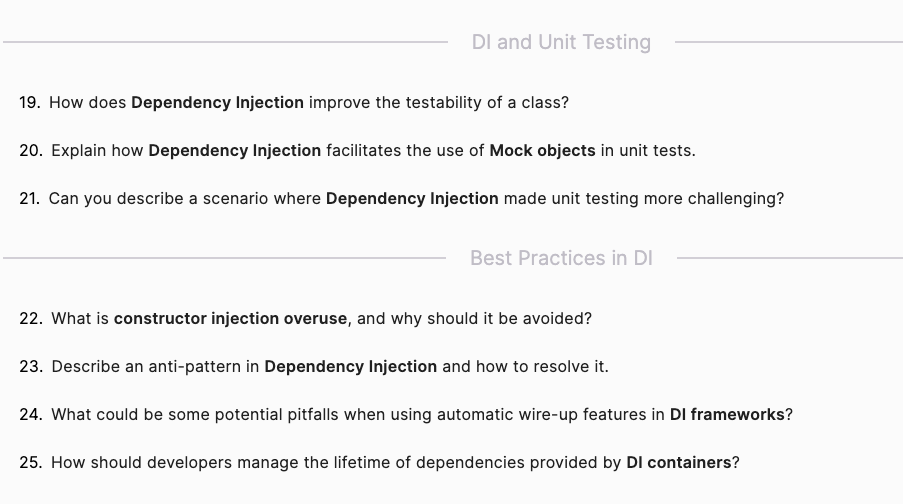
- How does Dependency Injection improve the testability of a class? Dependency Injection improves testability by allowing dependencies to be easily substituted with mock or stub implementations during testing. This decoupling enables isolated unit testing without relying on actual implementations of dependencies. Example:
   class Car(private val engine: Engine) {
fun start() {
engine.start()
}
}
@Test
fun testCarStart() {
val mockEngine = mock(Engine::class.java)
val car = Car(mockEngine)
car.start()
verify(mockEngine).start()
}- Explain how Dependency Injection facilitates the use of Mock objects in unit tests. Dependency Injection allows for the injection of mock objects instead of real implementations. This enables the testing of a class in isolation by controlling the behavior of its dependencies. Example:
   @Test
fun testCarWithMockEngine() {
val mockEngine = mock(Engine::class.java)
val car = Car(mockEngine)
car.start()
verify(mockEngine).start()
}- Can you describe a scenario where Dependency Injection made unit testing more challenging? Dependency Injection can make unit testing more challenging if the dependency graph is overly complex or if there are circular dependencies. This complexity can make it difficult to set up the necessary mock objects and configure the DI container appropriately for tests. Example:
   class A(private val b: B)
class B(private val a: A)
// Circular dependency makes DI and testing challenging
Best Practices in DI
- What is constructor injection overuse, and why should it be avoided? Constructor injection overuse occurs when a class has too many dependencies injected through its constructor, making it difficult to manage and understand. It can indicate that the class has too many responsibilities (violating the Single Responsibility Principle) and should be refactored. Example:
   class Car(
private val engine: Engine,
private val wheels: Wheels,
private val doors: Doors,
private val lights: Lights
) {
// Too many dependencies indicate potential design issues
}- Describe an anti-pattern in Dependency Injection and how to resolve it. One common anti-pattern is the Service Locator Pattern disguised as DI, where classes obtain dependencies through a locator rather than having them injected. This can be resolved by ensuring that dependencies are provided through constructors or setters instead. Example of Anti-pattern:
   class Car {
val engine = ServiceLocator.getEngine() // Anti-pattern
}
// Resolution:
class Car(private val engine: Engine)- What could be some potential pitfalls when using automatic wire-up features in DI frameworks?
- Hidden Dependencies: Automatic wiring can obscure dependencies, making it difficult to understand the class’s dependencies.
- Silent Failures: Misconfigurations might lead to runtime errors that are hard to trace.
- Performance Overhead: Large dependency graphs can lead to performance issues during the startup of the application. Example:
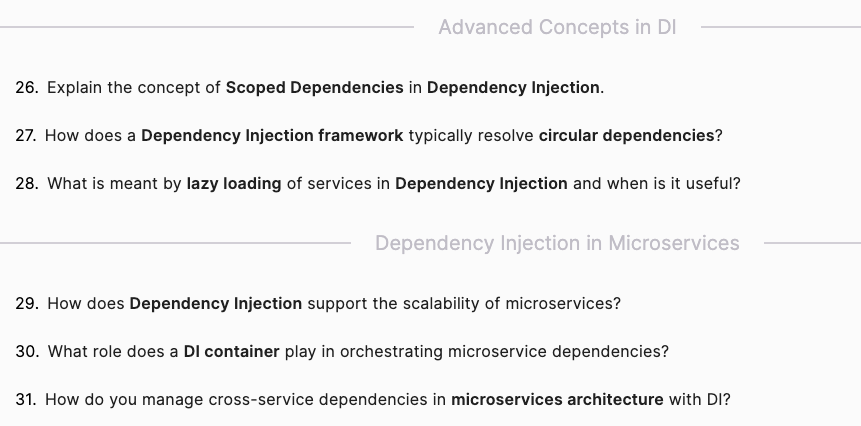
// Automatic wiring without clear documentation can lead to hidden dependencies- How should developers manage the lifetime of dependencies provided by DI containers? Developers should configure the DI container to manage the lifecycle of dependencies appropriately, using scopes like singleton, prototype, or request scope based on the application’s requirements. Example:
   val myModule = module {
single { Engine() }  // Singleton scope
factory { Car(get()) }  // Prototype scope
}
startKoin {
modules(myModule)
}
Advanced Concepts
Advanced Concepts in DI
- Explain the concept of Scoped Dependencies in Dependency Injection. Scoped dependencies are dependencies that have a specific lifecycle scope within an application. Common scopes include singleton (one instance per application), prototype (one instance per request), and request scope (one instance per HTTP request in web applications). Example:
   val myModule = module {
single { Engine() }  // Singleton: one instance throughout the application
factory { Car(get()) }  // Prototype: new instance each time requested
}
startKoin {
modules(myModule)
}- How does a Dependency Injection framework typically resolve circular dependencies? DI frameworks resolve circular dependencies by breaking the cycle through techniques like:
- Lazy Initialization: Deferring the creation of one of the dependencies.
- Provider Injection: Using a provider or factory to create the dependency when needed.
- Proxy Injection: Using a proxy or placeholder that is replaced with the actual dependency later. Example with Koin:
   val myModule = module {
single { A(get()) }
single { B(get()) }
}
class A(private val b: B)
class B(private val a: A)
startKoin {
modules(myModule)
}
// This setup would need further configuration to break the circular dependency- What is meant by lazy loading of services in Dependency Injection and when is it useful? Lazy loading in DI means that a service is not created until it is first needed. This can save resources and improve application startup time. It is useful in scenarios where some services might not be required during the initial phases of the application or are conditionally used. Example:
   val myModule = module {
single { Engine() }
factory { Car(get()) }
}
class Car(private val engine: Engine) {
// Engine is only initialized when first used
}
Dependency Injection in Microservices
- How does Dependency Injection support the scalability of microservices? Dependency Injection supports the scalability of microservices by promoting loose coupling and modularity. Each microservice can be developed, tested, and deployed independently, with its own set of dependencies managed separately. DI allows microservices to be easily extended or modified without affecting others. Example:
   // Example of DI in a microservice
@Service
class UserService(private val userRepository: UserRepository) {
fun getUser(id: Long): User = userRepository.findById(id)
}- What role does a DI container play in orchestrating microservice dependencies? A DI container in a microservice architecture ensures that each service’s dependencies are properly instantiated and managed. It helps in configuring and providing dependencies at runtime, ensuring that services remain loosely coupled and easily testable. Example:
   // Spring Boot example
@SpringBootApplication
class Application
fun main(args: Array<String>) {
runApplication<Application>(*args)
}
@Bean
fun userService(userRepository: UserRepository) = UserService(userRepository)- How do you manage cross-service dependencies in microservices architecture with DI? Cross-service dependencies in microservices architecture can be managed using service discovery, API gateways, and service registries. DI containers can be used within each microservice to manage internal dependencies, while external dependencies are handled through well-defined APIs. Example:
   // Using RestTemplate in Spring Boot to call another service
@RestController
class UserController(private val restTemplate: RestTemplate) {
@GetMapping("/user/{id}")
fun getUser(@PathVariable id: Long): User {
return restTemplate.getForObject("http://user-service/user/$id", User::class.java)
}
}
@Bean
fun restTemplate() = RestTemplate()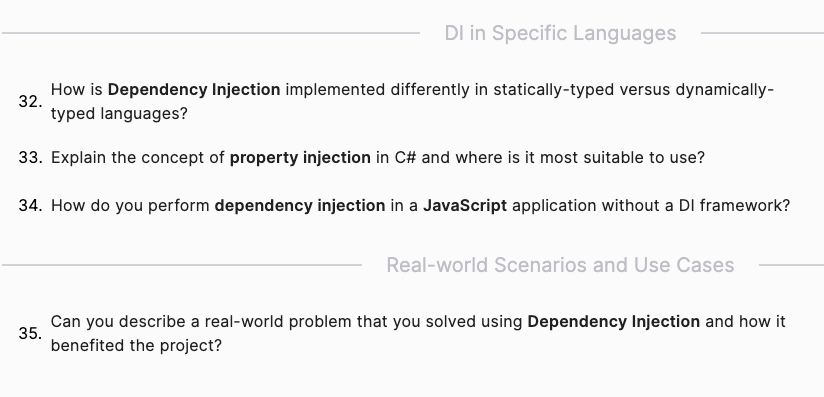
DI in Specific Languages
- How is Dependency Injection implemented differently in statically-typed versus dynamically-typed languages?
- Statically-typed languages: Dependency Injection is often more structured and type-safe, leveraging the language’s type system. DI frameworks can use annotations or attributes to define dependencies, and compile-time checks ensure type safety.
- Dynamically-typed languages: DI implementation is more flexible and can rely on conventions or runtime configuration. The lack of compile-time type checks requires more rigorous runtime testing to ensure correctness. Example in Kotlin (Statically-typed):
   class Engine
class Car(private val engine: Engine)
// DI using Koin
val myModule = module {
single { Engine() }
factory { Car(get()) }
}
Example in JavaScript (Dynamically-typed):
   class Engine {}
class Car {
constructor(engine) {
this.engine = engine;
}
}
// Simple manual DI
const engine = new Engine();
const car = new Car(engine);- Explain the concept of property injection in C# and where is it most suitable to use? Property injection involves setting dependencies through public properties rather than through the constructor or methods. It is suitable for optional dependencies that might not be needed at the time of object creation. Example in C#:
   public class Car {
[Inject]
public Engine Engine { get; set; }
public void Start() {
Engine.Start();
}
}
// Configuring property injection
var container = new Container();
container.Register<Car>();
container.Register<Engine>();
var car = container.GetInstance<Car>();- How do you perform dependency injection in a JavaScript application without a DI framework? In JavaScript, DI can be done manually by creating instances of dependencies and passing them to dependent objects. This manual approach provides flexibility but requires careful management of dependencies. Example:
   class Engine {
start() {
console.log("Engine started");
}
}
class Car {
constructor(engine) {
this.engine = engine;
}
start() {
this.engine.start();
console.log("Car is running");
}
}
const engine = new Engine();
const car = new Car(engine);
car.start();
Real-world Scenarios and Use Cases
- Can you describe a real-world problem that you solved using Dependency Injection and how it benefited the project? Problem: In a healthcare application, the business logic for handling patient data was tightly coupled with data access logic, making it difficult to test and maintain. Solution: By introducing Dependency Injection, we separated the business logic from the data access logic. We used a DI framework to inject the data access dependencies into the business logic classes. Benefits:
- Improved Testability: We were able to mock the data access layer, allowing us to write comprehensive unit tests for the business logic.
- Enhanced Maintainability: Changes to the data access layer no longer required changes to the business logic, adhering to the Single Responsibility Principle.
- Increased Modularity: The codebase became more modular, facilitating easier updates and feature additions. Example in Kotlin:
   // Data Access Layer
class PatientRepository {
fun getPatient(id: String): Patient {
// fetch patient data
}
}
// Business Logic Layer
class PatientService(private val repository: PatientRepository) {
fun getPatientDetails(id: String): Patient {
return repository.getPatient(id)
}
}
// Dependency Injection Setup
val appModule = module {
single { PatientRepository() }
factory { PatientService(get()) }
}
startKoin {
modules(appModule)
}






-
Tagged flutter, mobile-dev, react-native